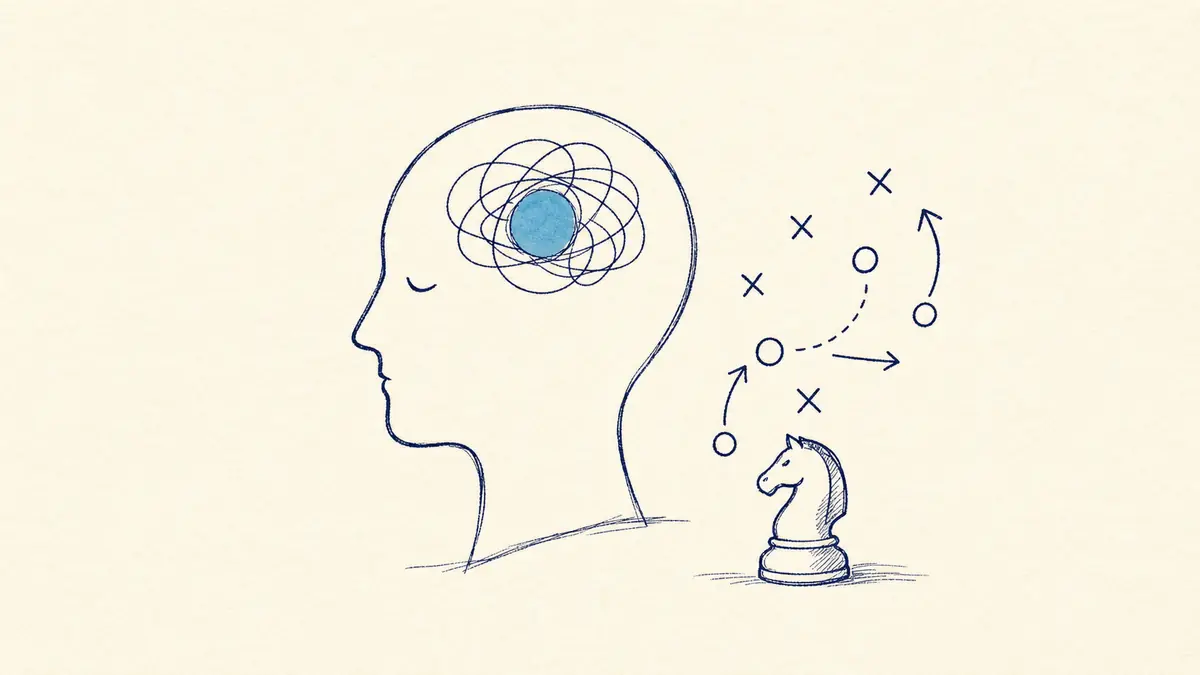
The INTJ weaknesses I see across the hiring desk aren't the cold-mastermind cliches. They're a much more specific set of failure modes that show up in the first 90 seconds of an interview and quietly cost good INTJ candidates jobs they should have gotten. This is the hiring-desk read on the INTJ personality type — what 15 years of interviewing has taught me about the Architect stereotype, and where it gets the type right and where it gets it badly wrong.
The INTJ pattern in 50 words. INTJ weaknesses cluster around the cold-open, over-qualifying language, and a redesign-the-system reflex. INTJ strengths cluster around pattern-recognition, independent execution, and calibrated confidence. The strong INTJs in my interviews are the ones who've already noticed the warm-up problem and built one specific fix for it.
What is an INTJ?
INTJ stands for Introverted, Intuitive, Thinking, Judging — one of the 16 personality types commonly used in interview self-assessment. The cognitive function stack is Ni-Te-Fi-Se: dominant Introverted Intuition (long-horizon pattern recognition that runs quietly in the background), auxiliary Extraverted Thinking (the part that structures decisions for the outside world), tertiary Introverted Feeling (private values that show up under stress), inferior Extraverted Sensing (the present-tense bandwidth that's lowest in the stack).
In hiring rooms, that stack looks like: the candidate sees the second-order risk in your scenario question before answering the first-order question, then has to translate the answer back down for a panel that's still on the surface question. I'm not a clinical psychologist. Use this as language for a pattern, not a diagnosis.
Top 5 INTJ strengths in interviews
These are the strengths that actually show up when an INTJ sits across from a hiring panel — not the romantic-mastermind version a personality blog will tell you to lean on.
1. Pattern-recognition under pressure
I'll give a scenario question — "the supplier just told you a key part is delayed two weeks, what do you do?" — and the INTJ names the second-order risk before stating the first answer. "I'd reroute the production schedule, but the bigger issue is whether this supplier has been late twice this quarter — that's the call I'd actually be making." That's the Ni-dominant move and it's the thing I'd pay for in a senior hire. Most candidates answer the surface question. INTJs answer the question one layer down.
2. Independent execution
INTJs describe 6-month projects they ran with minimal check-ins, and the numbers are credible. They don't oversell. "I ran the migration solo, finished it in 14 weeks against a 16-week plan, missed one edge case I caught in the post-mortem." That's the rhythm of a candidate who can actually be left alone with hard work. Most interview prep coaches will tell you to claim independence even if it isn't real; INTJs will under-claim it and the panel doesn't always know to correct for that.
3. Calibrated confidence
INTJs won't oversell their range. They'll tell you what they don't know plainly. "I haven't built that specific kind of integration before, but here's the closest analog I have, and here's what I'd want to learn first." That's gold to a hiring manager because it shortcuts a lot of reference-checking. Compare to the candidate who claims fluency in everything and you have to triangulate — the INTJ tells you the truth and trusts you to weigh it.
4. Strategic question-asking
The strongest INTJs flip the interview by minute 20. They ask one question the panel can't easily answer. "What does success in this role look like at month 18, and how is that different from what you measured the last person on?" That kind of question signals two things: they're thinking about whether the role is real, and they're already running the long-horizon version of it in their head. Panels remember this question after the interview.
5. Documentation reflex
INTJs reference previous decisions. "When we did this last year, the data said X — I'd want to check whether that still holds before making the same call again." That's a candidate who keeps notes, learns from past calls, and will not repeat your team's worst mistakes. It's also a tell that they'll bring receipts to disagreements at work, which is a feature or a bug depending on how confident your team is in its own decisions.
Top 5 INTJ weaknesses in interviews
Now the patterns the type-validation blogs skip. These are the INTJ weaknesses I see across the table, and most of them are fixable inside one round of prep.
1. Cold-open problem
The first 90 seconds of an INTJ interview are the most expensive 90 seconds of the conversation. The candidate walks in, the small talk is flat, the first answer is measured and a beat too long before delivery. Panels expecting warmth deflate. By minute 10 the INTJ has usually won them back — but in a competitive process, the first impression has already been written. The fix isn't fake warmth; it's one prepared anchor sentence for the first question that signals competence inside the first 15 seconds.
2. Over-qualifying
INTJ answers come with three caveats before the answer. "It depends on a few things — first, how the team is structured, and second, what the deadline looks like, and third, what we've already tried — but assuming those are X, Y, and Z, my answer is..." By the time the answer arrives, the panel has lost the thread. The exact same answer, with the caveats after the headline, lands twice as well. Same content, different framing.
3. Visibly-bored tells
When the interviewer asks a question the INTJ thinks is obvious, the face shifts. The eyebrows lift. The voice flattens. The candidate doesn't mean to broadcast "this is beneath me" — but the inferior-Se channel doesn't manage the surface signals well under boredom. Panels read it as arrogance. Strong INTJs notice this in mock interviews and learn to treat the obvious questions as warm-ups for the harder ones, rather than tax to be paid.
4. Collaboration discount
The INTJ describes solo work in vivid detail and team work in summary. "I led the migration; the team handled the rollout." That ratio is the tell. The panel — especially in a role that requires real collaboration — reads the summary as evidence that the team work wasn't real, or wasn't valued. The fix is small: pick one specific teammate-driven win, name the teammate's contribution in specific words, and let it sit in the answer at the same length as the solo win.
5. "I'd just rewrite the process" answer
Every job-fit question routes back to changing the system. "How would you handle the existing approval workflow?" "I'd probably restructure it." That answer is honest — but if the role isn't a redesign role, it tells the panel the candidate is going to be agitating to redesign things by month 4. Strong INTJs distinguish between "here's what I'd want to understand before changing anything" and "here's what I'd change," and they offer the first one in the interview.
What r/intj actually says about themselves
The most useful INTJ self-reporting I've seen comes from r/intj's recurring weakness threads. One of the top-voted posts (paraphrased): "Assumptions. Overthinking everything. Excessive self-criticism. Too much isolation. Being overly objective in decision-making or explanations. My emotions make me appear harsh and aggressive — unintentional, just my natural demeanor. I shut people out quickly." From the hiring desk, the "appears harsh and aggressive — unintentional" line is the single most useful self-diagnosis I've ever seen from inside the type. That gap between intent and perception is exactly what the cold-open weakness costs.
Another r/intj thread — "Stalled at my job because I'm an INTJ" — describes the experience of having to exert extra effort to achieve the same outcomes as coworkers because of a personality mismatch with the room. Paraphrased: the work is fine; the politicking around the work is the friction. That's a real pattern I see at hiring: the INTJs who've named this and have a workable answer ("I do my best work in environments that measure output over visibility, but I've learned to do the visibility work when it matters") get further than the ones who haven't.
A third thread — "INTJ leadership problems" — runs through the gap between having the strategic answer in your head and having the confidence to deliver it to a room you don't know yet. Paraphrasing the consensus: the ideas are there; the room-reading isn't. The hiring-desk version: an INTJ leader who has rehearsed three opening sentences for the first all-hands is going to outperform an INTJ leader with better strategy but no opener.
Stereotype vs. reality for INTJs
Stereotype: INTJs are mastermind strategists. Reality from 15 years of hiring: about half of the INTJs I've interviewed can translate the strategy back down to a Tuesday task list. The other half have brilliant frameworks that don't survive contact with what an entry-level employee actually does on a Tuesday at 2pm. The good INTJ leaders I've hired are the ones who can switch granularity — the bad ones live at one altitude.
Stereotype: INTJs are cold. Reality: cold is a defense, not a setting. The warm version of every INTJ I've ever hired exists; it just doesn't show up in the first 20 minutes. Panels that read the warm-up problem as the whole personality miss it. The candidates who can signal warmth earlier — usually through one specific reference to something the panel said, delivered in a normal voice — collapse the stereotype inside one answer.
Stereotype: INTJs work alone best. Reality: they work alone first, then need someone to argue against — and the argument is the work. The lone-wolf framing misses the most important thing about how INTJs deliver. They build a draft in private and then need a thoughtful adversary to sharpen it. The roles that fail for INTJs are the ones where there's no one to push back on the draft, not the ones where they have to collaborate.
How to interview an INTJ (or be one in an interview)
For hiring managers: Three questions that surface real INTJ patterns rather than stereotyped ones. (1) "Tell me about a project where the team's contribution mattered as much as yours — what did they do that you couldn't have done alone?" Tests the collaboration discount. (2) "Walk me through a process at your last job that you wanted to change but didn't — why didn't you?" Tests the redesign reflex. (3) "What's the question I should be asking you that I haven't yet?" Tests strategic question-asking and gives the INTJ a chance to land the flip-the-interview move they're often holding back.
For INTJs in interviews: Three framing tips. (1) Prepare one anchor sentence for the first answer that signals competence inside 15 seconds. The cold-open is your single biggest weakness — name it with action, not awareness. (2) Lead with the answer, then the caveats. "I'd start with X. Here's what I'd want to verify first." Same content, twice the landing. (3) When the obvious question comes, treat it as a warm-up. The panel is testing if you can talk to a Tuesday at 2pm employee — answer like you can.
If you want the cross-type read on what INTJs look like next to their closest relatives, the INTP strengths and weaknesses page covers the perceiving version of the same introvert-N machinery, and the ENTJ strengths and weaknesses page covers what happens when you flip the introvert to extravert — same Te-driven decisiveness, very different relationship with the room. For the wider context, our list of personal strengths and list of personal weaknesses pages have language INTJs can borrow when the interview doesn't go near personality type.
Frequently asked questions
What are INTJ weaknesses?
The five I see most often from the hiring desk are a cold-open problem in the first 90 seconds, over-qualifying answers with too many caveats up front, visibly-bored facial tells during basic questions, a collaboration discount where solo work is described vividly and team work in summary, and a redesign-the-process reflex that routes every fit question back to system change. These are predictable failure modes of a Ni-dominant brain in a 45-minute conversation — not character flaws — and they're all fixable inside one round of prep.
What are INTJ strengths and weaknesses in the workplace?
INTJ workplace strengths cluster around independent execution, pattern-recognition under pressure, and a documentation reflex that leaves a trail of decisions other people can reference. Weaknesses cluster around the warm-up problem in new teams, an aversion to politicking that gets read as not-a-team-player by people who don't know them yet, and a tendency to redesign systems before earning the right to. The strong INTJs at work are the ones who spend the first 90 days asking instead of redesigning, and the first 90 seconds of every meeting establishing context instead of jumping to conclusions.
Are INTJs good in interviews?
Yes — once they warm up. The warm-up takes longer than most panels allow, which is the core hiring-desk problem. The first 90 seconds of an INTJ interview are the most expensive 90 seconds of the conversation. The candidate who can name this directly ("I tend to read quiet early; by minute 10 you'll have a clearer read on me") often turns the tell into a strength. The INTJs who skip the warm-up entirely and lead with a sharp question land best.
What jobs are best for INTJs?
Roles where independent execution beats real-time collaboration and where strategic thinking is the deliverable: research, analyst, engineering lead, software architect, strategist, product owner, technical writer, founder/operator. INTJs underperform in pure customer-facing roles that require constant warmth or pure execution roles that reward steady maintenance over thinking. They overperform in roles where the company's hardest question is six months out and someone has to start answering it now.
One thing to do today
If you're an INTJ prepping for an interview, write down one specific anchor sentence for the first answer — the one that signals competence and warmth inside the first 15 seconds. Not generic ("happy to be here"); specific (something concrete you noticed about the company, the role, or the job description). The INTJs I've watched land the toughest roles are the ones who closed the cold-open gap with one prepared sentence. One sentence, written tonight, fixes the single most expensive INTJ weakness in the room.
Alex Host has spent 15+ years building, hiring for, and selling small businesses across the Midwest. He's interviewed 500+ candidates across roles ranging from cleaning crew to engineering lead.
This article is part of My Strengths and Weaknesses, a resource library covering interview prep, personality types, and self-assessment. The author also runs Hosted Brands, a SaaS portfolio for local service businesses.
Found this useful? The full list of 16 personality types and their strengths and weaknesses is the hub for this silo.